What to do when your pet rat dies, and how to look after the ones left behind
Wrap your rat in a soft cloth, let the cage mates spend a few minutes with the body, then keep your rat cool while you choose burial or cremation. Pet rats live only 1.5-3 years[1], so most keepers face this more than once, and it never gets easy.
By the Rodent Cremation Services editorial team · Updated September 24, 2026 · 5 min read · Sources
- What to do in the first few hours
- How to support grieving cage mates
- Burial, cremation and keepsakes for a rat-sized pet
The short answer
What should you do right after your rat dies?
Gently confirm your rat has died: no breathing, no heartbeat you can feel under the front legs, and no response. Then lay your rat on a cloth, let the surviving rats sniff them for five to fifteen minutes, and place your rat in a lined box somewhere cool. Burial or cremation can wait until tomorrow.
Unlike hamsters, rats almost never go into a cold, hibernation-like torpor, so a still, cool rat in a normal room has almost certainly died. If there's any doubt, for example faint gasping, call an emergency vet straight away, because rats can decline quickly with respiratory illness.
The first few hours
How do you care for your rat's body until burial or cremation?
- Use gloves or a cloth. Many older rats die of respiratory infections or tumors, and it's sensible hygiene to handle the body gently with a barrier.
- Lay them on their side, legs tucked. Stiffness begins within a few hours, so position them now if you want a peaceful shape for a viewing or a photo.
- Line a box. A shoebox with a fleece scrap from the cage, or their favorite hammock, works well. A familiar smell comforts the humans more than you'd expect.
- Keep them cool. Overnight in a cool room is fine; beyond that, bag the box and use the fridge. For waits of several days, freezing is an option if you plan to bury.
If your rat was euthanized, the vet will usually ask whether you want to take them home or have aftercare arranged. You don't have to answer on the spot. Most clinics can hold a small pet for a day or two while you think.
The rest of the mischief
Do rats grieve for a cage mate, and how can you help?
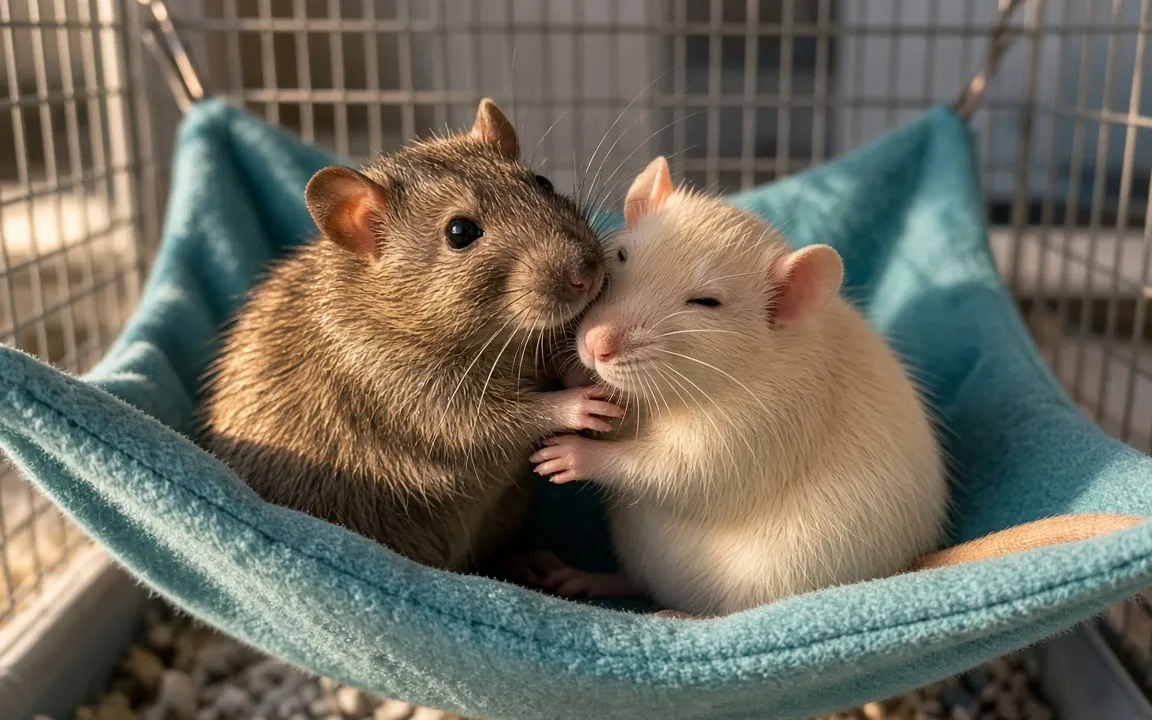
Rats are intensely social (the RSPCA's rat care advice says they should always live with other rats), and many keepers notice the survivors become quieter, sleep more or eat less for a few days after a companion dies. Letting them investigate the body seems to help them register the change, rather than simply wondering where their friend went. Most rats sniff, groom briefly and walk away.
- Give extra time out of the cage and more handling for the first week or two.
- Keep routines steady: same food times, same free-roam hours.
- Watch the appetite. A rat that stops eating for more than a day needs a vet.
- Plan for a lone rat. Rats shouldn't live alone long-term. If only one is left, talk to a rescue about introducing a friend, or about adopting your rat into an established group.
If your pet shared a cage, what did you do for the ones left behind?
Tap an answer to vote and see how others answered. Anonymous.
Choosing aftercare
Should you bury or cremate a pet rat?
Both are good choices. A rat is heavier than people expect, often 350 to 650 grams for an adult according to the Merck Veterinary Manual, and bucks can be larger still. That means a proper grave, at least two feet deep with a slab on top, especially after euthanasia. Since 2003[2], US euthanasia drug labels have warned that treated animals must be buried deeply or cremated to protect wildlife, as the Cornell Waste Management Institute notes.
Cremation suits keepers who rent, move often or have lost several rats over the years and want to keep them together. Communal cremation, with no ashes back, is typically 2x to 5x cheaper[3] than individual cremation for the same weight. Private cremation for a rat usually falls into a provider's smallest band, which in the US often means $100 to $175[4] for pets up to 30 lb. By our estimate, private cremation costs ~2.0x[5] the communal price at the median across eight markets. Our services page and local pages explain what's available.
| Rat | Typical weight | Likely ashes |
|---|---|---|
| Small doe | 250-350 g | About 8-17 g, roughly 2 to 3 teaspoons |
| Average adult | 400-500 g | About 12-25 g, one to two tablespoons |
| Large buck | 600-800 g | About 18-40 g, up to about three tablespoons |
Those estimates use the usual rule that ashes weigh about 3-5% of body weight[6]. Put your own rat's weight into the ashes weight estimator for a closer figure, and see our explainer on private vs communal cremation for rodents before you book.

Multi-rat households
Can several rats be cremated or kept together?
Yes, and it's a common request. Because rats live in groups and have short lives, keepers often lose two or three within a year. Some ask for each rat to be privately cremated and the ashes combined in one keepsake; others prefer a separate tiny vial for each. Both are fine, as long as you say what you want in writing before collection.
Ask for a per-rat price and whether a second small pet on the same day costs less. Our memorial budget planner adds up several pets and keepsakes so the total doesn't creep up without you noticing, and the questions to ask a rodent cremation provider cover the tray, the container and the paperwork.

Free tool
Memorial budget planner
Add up cremation, urn, keepsakes and a farewell so the total holds no surprises.
Remembering
What keepsakes work for a pet rat?
Rat keepers tend to love small, personal things: a clay print of those tiny hand-like front paws, a tuft of fur tied with thread, a photo of your rat stealing pasta, or the hammock they slept in. Ask for a paw print before cremation; it can't be taken afterwards.
A few owners choose preservation instead. One US studio quoted about $950[7] to freeze-dry a rat, far more than cremation, and the wait is months. Our guide to keepsakes and jewelry after rodent cremation compares the realistic options.
For you
Why does losing a rat hurt this much?
Rats are clever, affectionate and follow you around, so the bond can be as close as with a dog. Research on grief finds that closeness to the one who died, not the species, is overwhelmingly the strongest predictor[8] of how hard grief hits. Yet many rat owners hear dismissive comments; in the RSPCA's large pet-loss survey, 34.5%[9] of bereaved owners had been told "it's just a pet".
A rat who ran to the cage door every time you came home was never just a rodent.
Our page on grief after losing a rodent talks about repeated losses and how to cope with them. If you'd like someone else to find local aftercare, send us a few details and we'll reply by email.

Reader polls
What would you choose?
Vote anonymously and see how other readers answered. The results are live counts from people who visit this site, so they show real opinions, not a scientific sample.
If your pet shared a cage, what did you do for the ones left behind?
Tap an answer to vote and see how others answered. Anonymous.
How many hamsters, rats, mice or gerbils have you lost over the years?
Tap an answer to vote and see how others answered. Anonymous.
What was the hardest part of losing your pet?
Tap an answer to vote and see how others answered. Anonymous.


Questions people ask
How long can I keep my dead rat before burying or cremating?
In a cool room, a day is fine. Wrapped in a bag inside a box in the fridge, you can usually wait two to three days. If you need longer and plan to bury, freezing works well. For cremation, ask your provider before freezing, since a few prefer to know in advance.
Should I let my other rats see the body?
Most keepers recommend it. Give the surviving rats five to fifteen minutes to sniff and investigate, then remove the body. Many owners feel it helps the group adjust. If your rat died of a contagious illness, ask your vet first, and keep the visit short.
Can a rat live alone after its cage mate dies?
Rats are social animals and usually do poorly alone for long. A short period while you plan is fine, with plenty of extra attention. After that, consider introducing a new companion through a rescue, or rehoming your rat into a group. Older or ill rats sometimes do better staying with you and receiving lots of company.
How much does it cost to cremate a rat?
Most providers charge a rat at their smallest weight band. In the US, communal cremation for pets up to 30 lb is often $45 to $75 and private around $100 to $175, though some offer a lower small-animal rate. Ask for a written price that includes collection and the container.
What do rats usually die from?
In older pet rats, respiratory disease, mammary and pituitary tumors, and kidney problems are among the most common causes. Many simply decline with age after two years. If you're worried about something infectious affecting the rest of the group, your vet can advise on cleaning and what to watch for.
Is it normal to be this upset about a rat?
Completely. Rats are sociable, recognise their people and fit into daily routines, so their absence is felt all day. The grief can also be repeated, because rats live only two to three years. Talk to people who've kept rats, and be patient with yourself.


Sources and our estimates
- [1] Pet rats live about 1.5-3 years and weigh 350-650 g as adults. Merck Veterinary Manual - Table: Rats at a Glance.
- [2] Since 2003 the FDA has required euthanasia drug labels to warn that euthanized animals must be disposed of by deep burial, incineration or another approved method to keep scavenging wildlife from eating the carcass. Cornell Waste Management Institute & Penn State - Horse Mortality: Carcass Disposal Alternatives (2012), 2003.
- [3] The CMA found communal cremations are two to five times cheaper than the individual equivalent for the same pet weight. UK Competition and Markets Authority - Final report Appendix K: Cremations pricing, mark-ups and costs (24 Mar 2026), 2026.
- [4] CareCredit's pet cremation guide lists US communal cremation at $45-$75 and private at $100-$175 for pets up to 30 lb. CareCredit (Synchrony) - How Much Does Pet Cremation Cost? (Sept 2023), 2023.
- [5] The median price multiple of private (ashes returned) over communal cremation across 8 markets is about 2.0x, ranging from 1.25x (Tokyo) to 5.2x (Auckland). Our estimate: median(private_price / communal_price) same weight band: US CareCredit 51-70 lb midpoints (250/75) = 3.33x; Auckland 15-25 kg (445/85) = 5.24x; Norway 1-20 kg (3790/1190) = 3.18x; Singapore 10-20 kg (480/260) = 1.85x; Ontario 25-250 lb (549/279) = 1.97x; Tokyo 20-30 kg (38500/30800) = 1.25x; France 20 kg midpoints (200/95) = 2.11x; Germany range midpoints (270/145) = 1.86x. How we calculate.
- [6] Embrace notes cremated remains typically weigh about 3-5% of the pet's original body weight. Embrace Pet Insurance - Bury or Cremate Your Dog? Costs, Pros & Cons, 2025.
- [7] Freeze-drying costs about $850 for a bearded dragon, $950 for a hedgehog, rat or ferret, and $650–$1,350 for a small bird at one Ohio studio. Animal Family Pet Preservation – Pricing, 2026.
- [8] A Death Studies paper comparing pet and human loss found closeness to the deceased was overwhelmingly the strongest predictor of grief severity, whatever the species. Europe PMC abstract — Eckerd, Barnett & Jett-Dias, 'Grief following pet and human loss: Closeness is key', Death Studies (2016), doi:10.1080/07481187.2016.1139014, 2016.
- [9] 34.5% of bereaved pet owners were told 'it's just a pet'. RSPCA — Pet Loss Survey Results, 2026.
Find rat cremation or aftercare near you
Tell us what you need and where you are. We'll reply by email with clear options and prices so you can decide in your own time.